Ibrahim Consulting · Contract Risk · April 2026
Ibrahim Consulting · Contract Risk · April 2026
CONTRACT RISK · INSIGHT
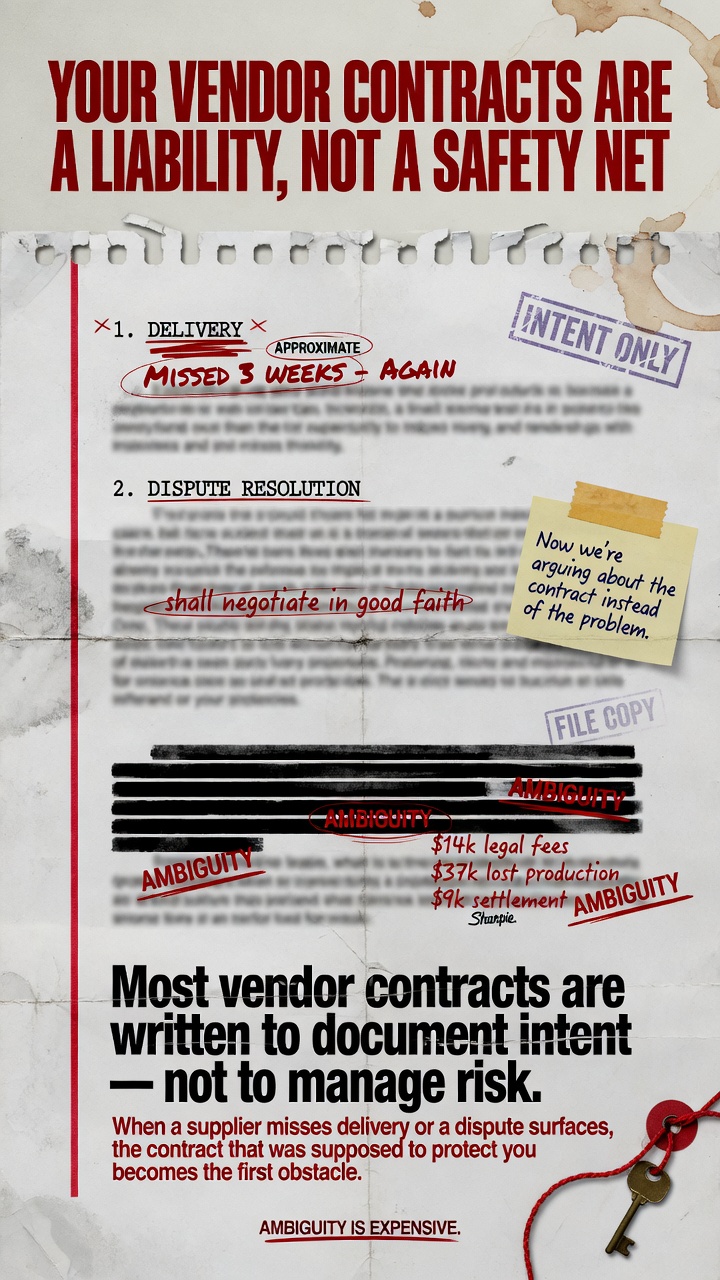
Most vendor contracts are written to document intent — not to manage risk. When a supplier misses delivery or a dispute surfaces, the contract that was supposed to protect you becomes the first obstacle.
Every procurement team has a version of the same story: a vendor misses a critical milestone, a delivery arrives defective, or a supplier simply goes quiet. You pull out the contract — and realize it was never written to handle this moment.
This is the central failure of most vendor contracts in Indonesia and across Southeast Asia. Drafted to create the legal appearance of an agreement, rarely designed as risk management instruments. Ambiguity is not neutral — it is expensive.
Vendor contract risk, wanprestasi, and dispute resolution under Indonesian law.
Indonesia · KUHPerdata Buku III · BANI 2025 Rules · UU No. 30/1999.
Contract failures are rarely isolated — they are structural and preventable.
CONTRACT FAILURES
Structural weaknesses that appear in vendor contracts regardless of industry or contract value — and the legal consequences when they surface.
A contract specifies what must be delivered and when — but says nothing about the consequence of lateness. Without an explicit penalty clause (klausula denda) or a right of termination tied to missed deadlines, late delivery becomes a negotiation, not a breach.
No penalty clause means lateness is a commercial discussion, not a legal obligation. Vendors have no incentive to prioritize your delivery.
Include an explicit klausula denda per day of delay. Tie material deadlines to automatic rights of termination after a defined cure period. Issue a formal somasi under Pasal 1238 KUHPerdata to establish the legal clock.
Pasal 1243 KUHPerdata: ganti rugi covers biaya (costs), rugi (direct losses), and bunga (lost profits) — but each must be proven with documented evidence.
When a contract says "goods meeting the agreed specification" but that definition lives only in a purchase order not explicitly incorporated by reference, the vendor can claim defective goods are within spec. Courts interpret ambiguity against the drafting party.
Specification in an attachment not referenced in the contract body may be excluded from evidence. Conformity becomes a matter of interpretation, not law.
Define quality standards, tolerances, and acceptance criteria in the contract body. Explicitly incorporate all attachments by reference. Specify who determines conformity and within what timeframe.
Pasal 1267 KUHPerdata: the aggrieved party must elect between compelling performance or termination with damages. This choice is strategic — and often irreversible.
If a contract is silent on dispute resolution, the default is litigation through Indonesia's general courts — which routinely takes years. The smarter alternative is a BANI arbitration clause, updated to reflect the 2025 Rules effective 2 January 2025.
No dispute clause means litigation by default. Indonesian court proceedings routinely take 3–5 years before a final, executable judgment. Cost and delay destroy commercial relationships.
Include a three-step escalation: (1) 14-day good-faith negotiation, (2) mediation under PERMA No. 1/2016, (3) binding BANI arbitration under the 2025 Rules. Specify seat, governing law, language, and number of arbitrators.
UU No. 30/1999 governs arbitration. BANI awards are final and binding under Pasal 60. CC Decision No. 100/PUU-XXII/2024 (Jan 2025) clarifies domestic vs. international award status — critical for cross-border enforcement strategy.
LEGAL REFERENCES
This analysis is grounded in KUHPerdata Buku III (Pasal 1238, 1243, 1245, 1267, 1338), UU No. 30/1999 on Arbitration, the 2025 BANI Arbitration Rules effective 2 January 2025, and Constitutional Court Decision No. 100/PUU-XXII/2024. Sources include Assegaf Hamzah & Partners, ATD Mori Hamada, Chambers & Partners 2025, and peer-reviewed journals on Indonesian contract law.